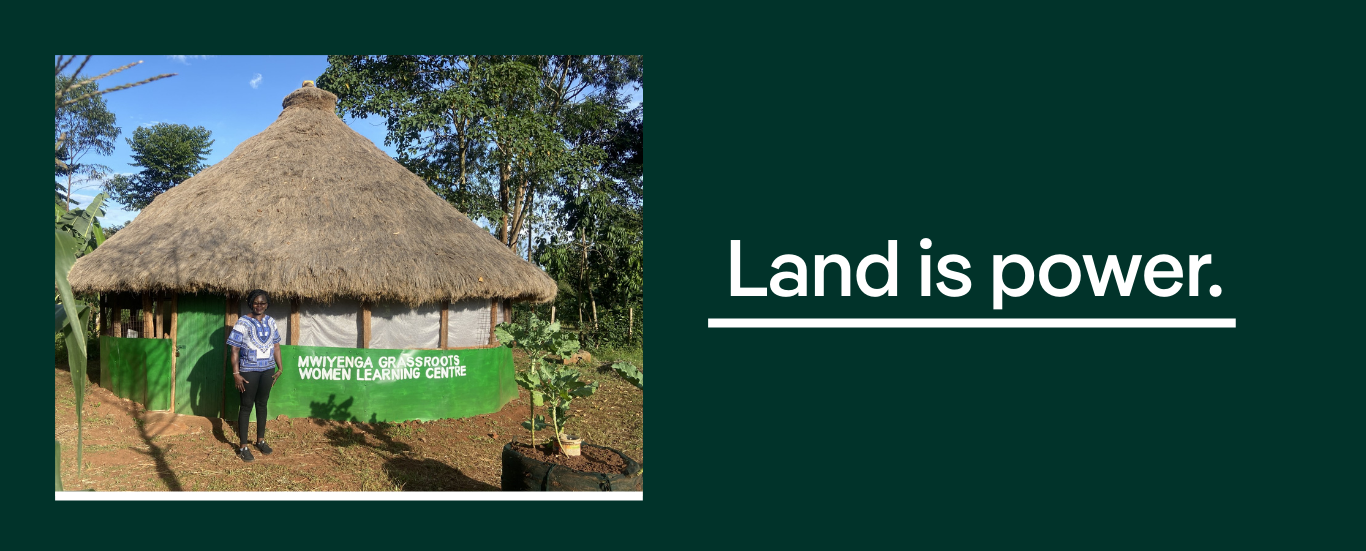
Land is power. And the roots of change are grounded in community action.
When women are locked out of land access, they’re locked out of opportunity. We work with grassroots organizations to develop solutions that rebalance this power - transforming land access into a catalyst for equity, security, and lasting change.
Access to land - and justice
Land is an essential resource, sustaining the lives and livelihoods of people around the world. For income alone, 3.7 billion people rely on agriculture and agroforestry.<sup> </sup>
Women are the backbone of these efforts in emerging economies, producing 60-80% of food. Armed with invaluable knowledge of local plants, ecosystems, and sustainable farming practices, women also drive climate action. Even so, less than 15% of landholders worldwide are women.
In rural Kenya, women likewise make up nearly half the agricultural workforce but face major barriers to accessing land. Discriminatory inheritance practices and weak implementation of legal frameworks leave land ownership largely in men’s hands. Without rights to lease or own land, women face even greater risks of displacement, marginalization, economic loss, and violence. This erodes women’s decision-making power, stunting their ability to apply their knowledge and thrive.
We work with grassroots organizations to change this power dynamic. Together with our partners, we’ve cultivated two community-led solutions that meet immediate needs, inform local advocacy and national policy, and support transformational change from the ground up.
- Haki Ardhi – the Women’s Land Rights Reporting tool – enables women to easily and confidentially report land tenure violations, as well as access support services to settle conflicts and claim their rights.
- The Land Leasing Guidelines are a community-driven innovation that makes land access more equitable. By formalizing informal land agreements, they both strengthen tenure security for women and reduce conflicts between lessors and lessees.
Haki Ardhi - Women's land rights reporting tool
TMG Research, Rainforest Foundation UK and Kenya Land Alliance, as well as community-based organizations Shibuye Community Health Workers, Sauti ya Wanawake, and Taita Taveta Human Rights Watch, developed and piloted Haki Ardhi – a powerful new digital tool that fosters bottom-up monitoring and reporting of land rights violations.
This tool provides women a safe avenue to report on land rights conflicts and related to gender-based violence. Through data collection and use, it makes women’s rights violations more visible, enabling local organizations to advocate for an effective response.
Data drives accountability
Data enables organizations to provide targeted support to women, and serves as an evidence base of recurring or urgent issues. This enables local organizations to carry out targeted advocacy work and hold duty bearers accountable. For example, in Kakamega and Taita Taveta counties, women experience the constant fear of forced eviction due to tenure-insecurity. To help alleviate this, Kenya Land Alliance presented Haki Ardhi data to the Judiciary in both counties to demonstrate a backlog of unresolved tenure cases that violated women’s land rights. This prompted the Judiciary to intervene by using the data to identify cases that have long overstayed in court. A week deadline to resolve those cases was then agreed upon to ensure women in both counties can access justice through court processes.
Learn more about Haki Arhi's impact in this video!
Land leasing guidelines
The Land Lease Guidelines are a social innovation that enhance equitable land access through leasing, improving tenure security for women and marginalized groups. By utilizing TMG's research on land access in Kakamega County, Kenya, Shibuye Community Health Workers co-developed the guidelines through a participatory process, bringing together local leaders, landowners, and farmers - women, men and youth - to shape an approach to land leasing that worked for everyone. By formalising informal land agreements, making the guidelines widely accessible, and providing clear procedures for lease agreements, people experience less land conflicts and women's land access. Shibuye also provides agricultural trainings, where women learn sustainable farming techniques and share with other women in their communities. Shibuye’s hands-on training site teaches a broad range of new techniques, like cultivating climate tolerant crops, soil rehabilitation, composting, bee keeping, water management and more.
This exponentially multiplies the impact of everyone’s efforts, creating a strong community of practice along the way.
So far, 136 women and 81 men have registered lease agreements, including particularly marginalized groups like single women and widows, and report having more stable access to land. With long-term tenure in place, farmers have doubled their use of sustainable land management practices, leading to greater food production, food security and income.
Women’s access to land has also shifted social perceptions, as men increasingly recognize women’s economic contributions. Finally, the success of the initiative has gained county-level support, with the Governor of Kakamega now actively promoting the Land Lease Guidelines.
About Shibuye Community Health Workers
Shibuye Community Healthcare Workers is a grassroots, women-led organisation founded in 1999 by 15 women caregivers. Originally established to enhance women's health during the HIV/AIDS epidemic, Shibuye has expanded to advocate for women's rights to land and resources. With over 2,040 members including caregivers, community paralegals, women farmers and market vendors, they work in 18 wards across Kakamega County and work with other women-led organisations in eight other counties across Kenya.
“Grassroots women are pioneering innovations every day to adapt to climate change,” says Shibuye’s founder, Violet Shivutse.
“When the SDGs were formulated, there was a very strong discussion on localising them. But they didn't know what that would look like. For us as grassroots women, we took this as a very big opportunity to ensure that we are going to be the ones localising the SDGs. We are the ones training our communities and linking our work to these goals. That's why it's important to bring the grassroots women to the table and amplify their voices globally.”